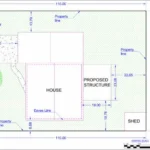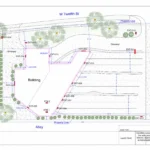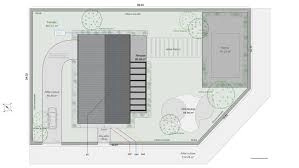
When I review residential permit applications, I frequently see preventable delays caused by incomplete or improperly prepared site plans. Building departments enforce strict zoning and submission standards, and any failure to clearly demonstrate compliance with setbacks, property boundaries, structure placement, or formatting requirements will result in rejection or corrections. Most residential site plan rejections stem from avoidable technical deficiencies that can be addressed with proper preparation.
1. Inaccurate or Missing Property Boundaries
Property boundaries form the foundation of every residential building permit site plan. If boundary lines are missing, improperly labeled, or inconsistent with official parcel data, the building department cannot verify zoning compliance.
Common issues I see include:
- Boundary dimensions that do not match county parcel records
- Property lines drawn without scale
- Corner points not identified
- Easements omitted
When property boundaries are inaccurate, setback calculations become unreliable. That alone can trigger a site plan rejected for permit status.
2. Setbacks Not Clearly Labeled or Calculated Incorrectly
Setback compliance is one of the primary reasons building department site plan rejection occurs. Zoning regulations dictate minimum distances between structures and property lines. If those distances are not clearly labeled, reviewers cannot confirm compliance.

Typical errors include:
- No setback dimensions shown
- Incorrect front, rear, or side yard calculations
- Proposed structures placed inside restricted zones
- No identification of required vs. provided setbacks
Building officials prioritize zoning compliance before structural review. If setbacks are unclear, your permit will not move forward.
3. Proposed Structure Placement Lacks Dimensioning
A residential site plan must clearly define the size and placement of the proposed improvement. Whether it is a deck, garage, shed, pool, or home addition, incomplete dimensioning leads to building permit site plan corrections.
Frequent mistakes include:
- Missing length and width measurements
- No distance between proposed structure and existing house
- No square footage indication where required
- Unclear orientation on the lot
Reviewers must confirm lot coverage compliance and spacing. If dimensions are incomplete, they cannot perform that assessment.
How to prevent this issue:
I always include:
- Exact structure dimensions
- Distances to all relevant property lines
- Distance to existing structures
- Clear labeling of “existing” versus “proposed” elements
This eliminates ambiguity during the permit review process.
4. Omission of Existing Structures and Improvements
A common cause of residential site plan rejection is submitting a drawing that only shows the proposed structure. Building departments require a complete view of the property layout.
Missing elements often include:
- Primary residence footprint
- Detached garages
- Pools or patios
- Driveways
- Accessory structures
Without a full property context, zoning officials cannot evaluate total lot coverage or structural spacing.
5. Absence of Scale, North Arrow, or Professional Formatting
Professional formatting standards are not optional. Every residential building permit site plan must include:
- Defined drawing scale
- North arrow
- Legible labeling
- Clean, organized layout
When these elements are missing, the plan appears incomplete. Review officers rely on scale to verify distances. Without it, the plan may be immediately flagged.
Low-resolution files and inconsistent formatting also contribute to permit site plan requirements not being satisfied.
How to prevent this issue:
I apply a consistent professional format that includes:
- Clearly stated scale (e.g., 1” = 20’)
- Visible north arrow
- High-resolution digital PDF output
- Proper title block and labeling
Presentation quality directly influences approval speed.
6. Failure to Address Easements and Access Points
Many site plans get rejected because easements, right-of-way areas, or driveway access points are not shown. These elements affect where construction can legally occur.
Typical oversights include:
- Ignoring utility easements
- Failing to mark drainage easements
- No driveway or curb cut location shown
- Access not connected to a public road
Building departments must ensure proposed structures do not encroach into restricted areas.
7. Non-Compliance with Local Submission Guidelines
Even technically accurate site plans can be rejected if they do not follow municipality-specific submission rules.
These may include:
- Required paper size or PDF dimensions
- Specific labeling standards
- Required zoning classification notation
- Digital portal upload formatting
- Additional notes or disclaimers
Failure to follow these administrative requirements often results in site plan corrections required notices.
The Cost of a Rejected Residential Site Plan
Permit delays impact more than timelines. They disrupt contractor schedules, material ordering, inspections, and project financing. A rejected residential site plan can add unnecessary days or weeks to your project.
Building departments do not reject plans without reason. Most rejections are based on measurable compliance failures. When I prepare a site plan, I treat clarity, zoning accuracy, and formatting precision as non-negotiable standards.
How to Strengthen Site Plan Approval Probability
To reduce the risk of residential site plan rejection, I focus on:
- Accurate boundary verification
- Explicit setback labeling
- Complete dimensioning of proposed improvements
- Full property context
- Professional drafting standards
- Local submission alignment
Each of these components contributes to a smoother site plan approval process.
When a residential site plan is prepared with zoning compliance and technical clarity in mind, building departments can review and approve it efficiently. Precision is not optional in permit applications; it is essential.
Conclusion
Residential site plan rejection is almost always preventable when accuracy, zoning compliance, and professional formatting are prioritized from the beginning. Building departments reject plans based on measurable deficiencies, not minor technicalities. When boundaries, setbacks, structure dimensions, and local submission requirements are clearly addressed, permit approvals move significantly faster. Careful preparation protects your timeline and reduces costly revisions.
Why Choose Us
We prepare permit-ready residential site plans with precision, compliance awareness, and professional drafting standards.
- Verified GIS parcel data used for accurate property boundaries
- Clearly labeled setbacks and structure dimensions to reduce corrections
- Professional formatting aligned with municipal submission standards
- 24-hour turnaround for most residential projects
- Responsive revision support if the building department requests updates
Frequently Asked Questions
1. Why do building departments reject residential site plans?
Most rejections occur due to missing setbacks, inaccurate boundaries, incomplete dimensions, or failure to meet local formatting requirements.
2. Can incorrect setback calculations cause permit denial?
Yes, incorrect setback measurements are one of the most common reasons a site plan is rejected during zoning review.
3. Does a residential site plan need to show existing structures?
Yes, building departments require a complete property layout to evaluate lot coverage and spacing compliance.
4. What happens after a site plan is rejected?
The building department issues a correction notice outlining required revisions before resubmission.
5. How can I reduce the risk of site plan rejection?
Ensure accurate boundary data, clearly labeled setbacks, complete structure dimensions, and compliance with local submission guidelines before filing your permit