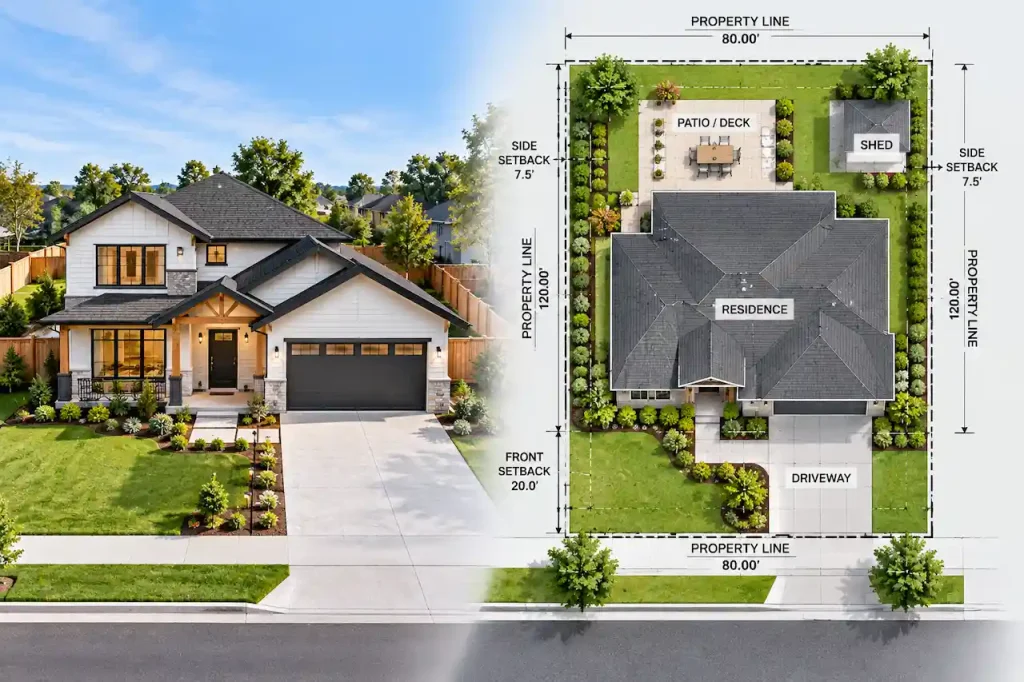

Adding a deck is one of the most common residential projects across the United States — and one of the most commonly rejected permit applications when the plot plan (site plan) is incomplete. Many of these issues stem from missing details outlined in standard Residential Site Plans for Permits and failing to meet local Site Plan Drawing Requirements.
I’m Engineer Wasim of Site Plans Online USA. My team prepares deck permit site plans every week. This guide covers exactly what a deck permit plot plan must include and helps you avoid the common mistakes explained in Why Site Plans Get Rejected.
Do Deck Permits Always Require a Plot Plan?

In most US jurisdictions, yes. A deck that requires a building permit (most do, with some exceptions for very small ground-level platforms) also requires a site plan showing where the deck sits on the property and how it relates to the property lines. These requirements are often tied to broader Zoning Laws for Pools, Fences, and Decks, which regulate placement and spacing.
When a deck usually requires a permit:
- Attached to the house
- Over 200 square feet
- Over 30 inches above grade at any point
- Covered or roofed (pergola with solid roof, patio cover), these may also require exterior documentation similar to Elevation Plan Drawing Services
When a permit may not be required (varies by jurisdiction):
- Under 200 sq ft
- Under 30 inches above grade
- Not attached to the primary structure
Check with your building department before assuming no permit is needed.
What a Deck Permit Plot Plan Must Include
Universal elements (all jurisdictions):
- Property boundaries with dimensions
- Existing house footprint with dimensions (similar to what is shown in a Site Plan for House Addition or Remodel)
- Proposed deck location labeled “PROPOSED DECK.”
- Deck dimensions (length × width)
- All setback dimensions labeled — distance from deck to every property line
- Deck height above grade labeled (especially if elevated)
- Attachment point to the house shown
- North arrow, scale (1″=20′ standard), graphic scale bar
- Title block with address, APN, owner, preparer, and date.
Almost always also required:
- Impervious surface calculation — a deck adds to your total hard surface coverage. Calculate: existing hard surfaces (house + garage + existing patio + driveway) + proposed deck area. Express as a percentage of the lot area. Compare to your zoning maximum (typically 50–65% residential).
- Distance from lot line to nearest deck edge — measured horizontally, not vertically.
If you want to avoid delays and get your permit approved faster, you can Get My Deck Permit Site Plan or use the Cost Calculator to estimate your project instantly.
Deck Setbacks — What Most US Jurisdictions Require

Deck setbacks depend on whether the deck is attached to the house or freestanding, and whether it’s covered or open.
Attached deck (most common): Treated as part of the principal structure in most jurisdictions — must meet the same setbacks as the house. Typical R-1 residential:
- Front: 25 ft
- Rear: 20 ft
- Side: 7.5 ft
Freestanding covered structure (pergola with solid roof, patio cover): Often treated as an accessory structure with reduced setbacks — typically:
- Rear: 5 ft
- Side: 5 ft
Height consideration: Some jurisdictions apply different setback rules for elevated decks. A deck over 30 inches high may be subject to principal structure setbacks regardless of whether it’s technically attached.
Verify your specific jurisdiction’s rules. We research this for every plan we prepare.
Elevated Decks — Additional Requirements
For decks elevated more than 30 inches above grade:
- Structural detail required — post sizes, beam sizes, joist span. Some jurisdictions accept simplified structural tables from the IRC; others require a PE-stamped structural plan for anything above a certain height.
- Staircase shown on plot plan — show where the stairs access the deck from grade.
- Guardrail notation — decks over 30 inches require guardrails per IRC Section R312. Note the guardrail height (minimum 36 inches, 42 inches for commercial) on the plan.
Covered Decks and Pergolas — Different Rules
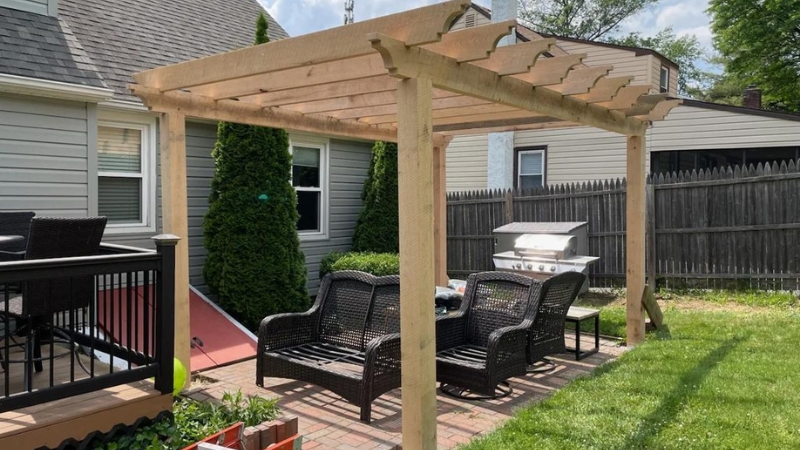
A pergola or covered patio with a solid roof is treated differently from an open deck in most jurisdictions. Covered structures:
- May require a separate electrical permit if lights or fans are added
- May be subject to stricter setbacks than open decks
- Add more significantly to the impervious surface calculation
- May trigger additional structural review if the roof has a snow load requirement
Always check whether your deck project is “covered” or “open” under your local code definition — the treatment can differ significantly.
Common Deck Permit Plot Plan Rejection Reasons
- Setbacks not labeled — every deck rejection in my experience includes at least one unlabeled setback.
- Attachment point missing — reviewers want to see how the ledger board connects to the house.e
- Impervious surface not calculated — very common for dec, ks adding significant area.
- Height not noted — required if deck is elevated
- Staircase not shown — if the deck has stairs, they must appear on the plan
Use our Construction Site Plan Checklist before submitting.
Take the Next Step With Confidence
Avoid unnecessary delays and prepare for your permit application with greater confidence. Use our free tools to review your project and understand the next steps before moving forward.
ADU Feasibility Checker
Check whether your property may be suitable for an accessory dwelling unit.
Check ADU Feasibility 02Site Plan Checker
Review your drawing for common missing details and potential submission issues.
Review Your Site Plan 03Permit Requirements Checker
Identify the likely permit requirements for your location and project type.
Check Requirements 04Site Plan Cost Calculator
Get a quick site plan cost estimate based on your project requirements.
Calculate Your CostGet Your Permit Drawing Scope Reviewed
Send us the property address and project details. We’ll help identify the likely drawing scope and next step.

Engineer Wasim
Civil/Structural Engineer and founder behind Site Plans Online USA. His permit-drafting experience dates back to 2015, supporting residential, commercial, structural and site-development projects.
Learn More About Site Plans LLC →