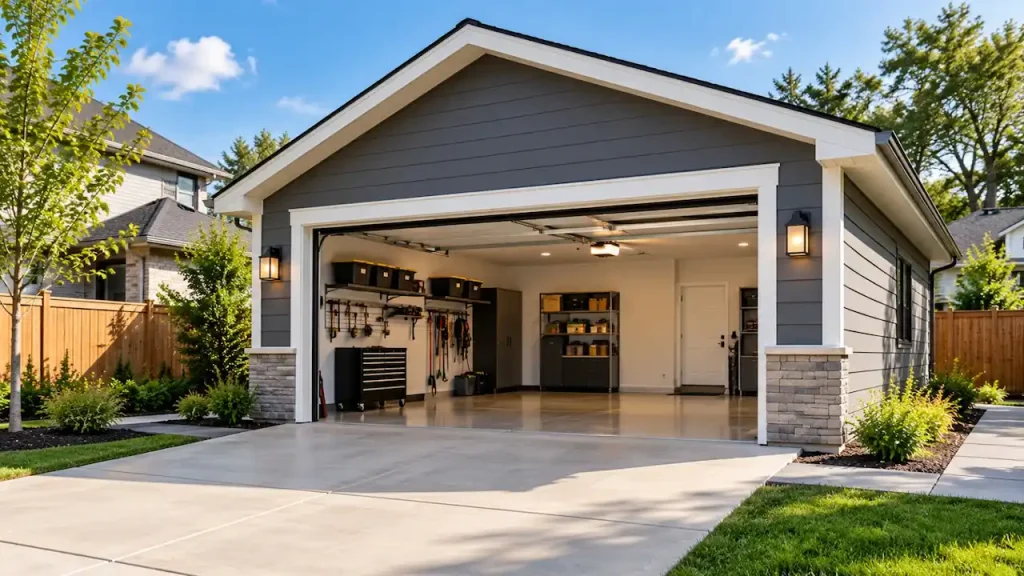
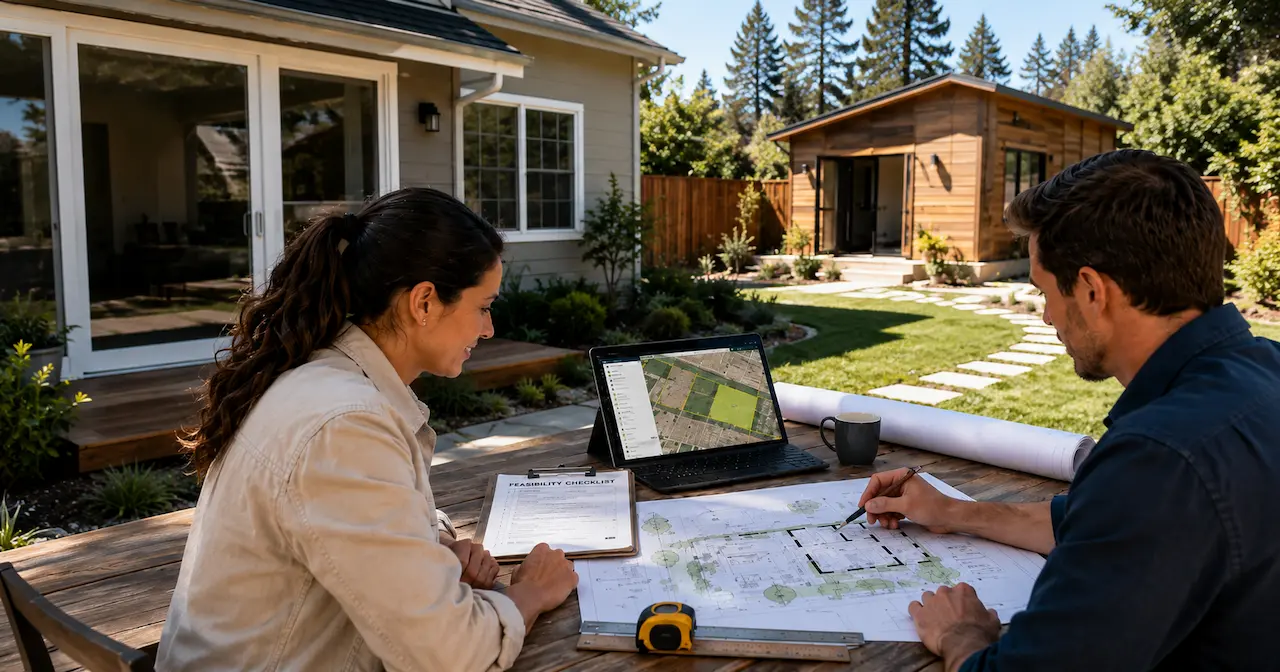
You’ve heard that an ADU could generate rental income, house a family member, or increase your property value. You want to build one. But before you hire a designer, talk to a contractor, or even sketch a floor plan — someone tells you that you need a feasibility study.
What is an ADU feasibility study? Do you actually need one? What does it cost? And can you do one yourself?
I’m Engineer Wasim of Site Plans Online USA. This guide answers all of it — covering every factor a real feasibility study examines, how the process works from initial assessment to site plan, and when a professional study is worth the investment.
What Is an ADU Feasibility Study?
An ADU feasibility study is a structured analysis of whether your specific property can support an accessory dwelling unit — and if so, where, how large, and under what conditions.
The word “feasibility” means exactly what it sounds like: is this project feasible? Can it actually be built on your lot, within your budget, under your local zoning code, and through your jurisdiction’s permit process?
A proper feasibility study answers four questions:
- Zoning and legal eligibility — Is an ADU permitted on your property under current zoning laws?
- Physical site capacity — Does your lot have sufficient space, access, and conditions to accommodate an ADU?
- Utility and infrastructure capacity — Can your existing water, sewer, electrical, and gas systems support an additional dwelling unit?
- Financial and permit viability — What will it cost, what approvals are required, and does the project make economic sense for your situation?
A feasibility study doesn’t design your ADU. It tells you whether designing one is worth your time and money. Think of it as due diligence before the real investment begins.
Why ADU Feasibility Matters More Than Homeowners Expect
The ADU market across the United States has expanded dramatically since California reformed its ADU laws (SB 9, AB 68, AB 2221) and other states followed with their own ADU-friendly legislation. The result: more homeowners are exploring ADU projects than ever before.
But enthusiasm and eligibility are two different things.
The factors that determine ADU feasibility — lot size and setbacks, zoning and HOA restrictions, utility capacity, existing structure condition, and local permitting timelines — are interconnected, and working through them systematically is the only way to get a reliable answer.
A homeowner who skips feasibility and goes straight to design often discovers mid-project that:
- The rear setback doesn’t leave enough room for a detached ADU of the size they wanted
- The electrical panel is a 100-amp service that can’t handle a second dwelling unit
- Their HOA covenant restricts short-term rental of ADUs, which was the entire financial justification
- The lot slopes enough to require grading that adds $30,000 to the project budget
These aren’t edge cases. They’re common. A feasibility study catches them before you’ve spent money on design, engineering, and permit applications.
The 7 Factors Every ADU Feasibility Study Examines
1. Zoning Classification and ADU Eligibility
The first question is always whether your property’s zoning classification permits an ADU at all.
In California, state law (AB 68, AB 2221) requires most single-family residential zones to allow at least one ADU and one Junior ADU (JADU). This state law overrides local restrictions in most cases — but “most” isn’t “all.” Properties in certain historic districts, coastal zones, or with unusual deed restrictions may have limitations.
Outside California, eligibility varies significantly by state and municipality. Some cities have actively expanded ADU rights. Others still have restrictive ordinances that limit ADU development to specific zone types, lot sizes, or property configurations.
Many jurisdictions establish minimum lot size thresholds for ADU development. Traditional zoning often required 5,000–10,000 square feet minimum. Reformed codes may allow ADUs on lots as small as 3,000 square feet. Some progressive cities have eliminated minimum lot size requirements entirely.
What a feasibility study checks:
- Property’s zoning district and whether ADUs are permitted by right, conditionally, or not at all
- Whether state ADU preemption laws override local restrictions
- Owner-occupancy requirements (California eliminated this for ADUs built before 2025)
- Rental restrictions — some jurisdictions limit ADUs to long-term rental only
- HOA covenants — these are private agreements that can restrict ADU use regardless of what zoning allows
2. Lot Size, Setbacks, and the Buildable Envelope
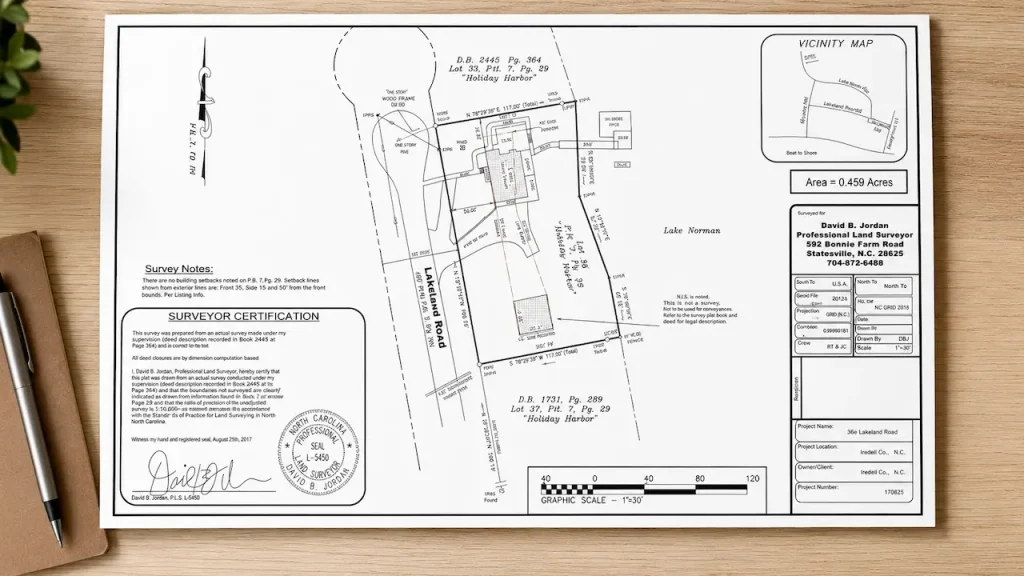
Assessing property data includes building standards, development requirements, zoning setbacks and height limits, ADU regulations, lot coverage ratios, solar requirements, plus any regulatory or legal constraints.
Even when an ADU is permitted, your lot must have enough space after setbacks are applied to actually fit a structure.
California setbacks under state law (most jurisdictions):
- Detached ADU: 4 feet minimum from rear and side property lines
- Front yard: typically the same setback as the principal structure
- Corner lots: setback from the street-side property line is typically 5 feet
Why setbacks matter more than lot size: A large lot with a large house placed close to the rear can have very little usable backyard after setbacks are applied. A smaller lot with a house placed forward may have excellent ADU capacity in the rear.
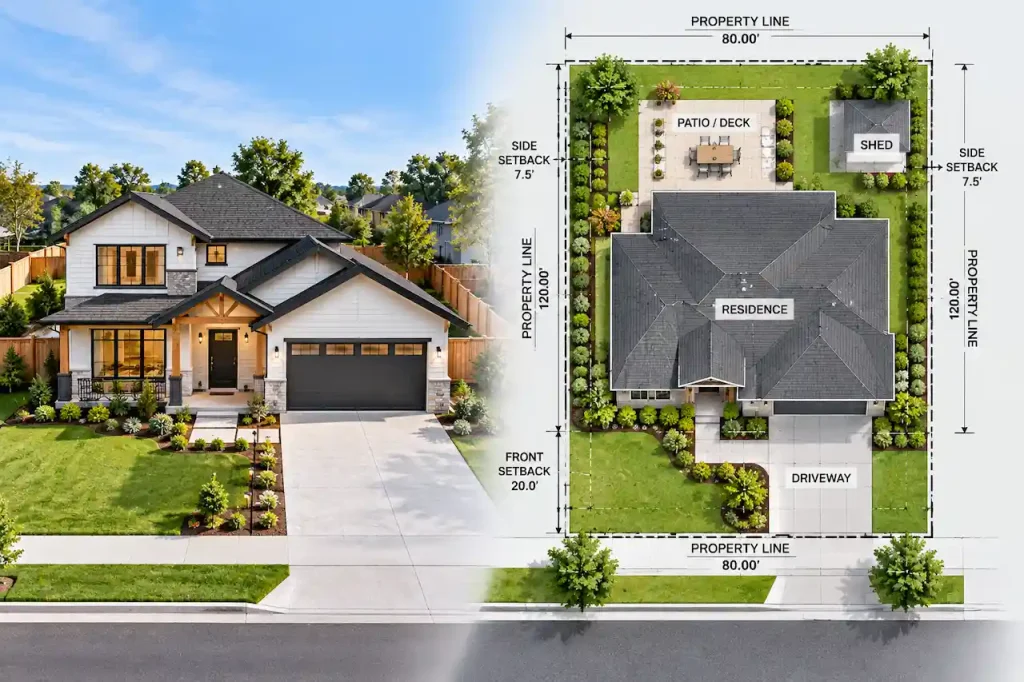
The “buildable envelope” is the area of your lot that remains after all setbacks are applied. A feasibility study maps this envelope and determines whether a useful ADU — typically at least 400 to 600 square feet — fits within it.
Lot coverage is the related constraint. Most residential zones cap the percentage of the lot that can be covered with structures. Adding an ADU adds to this coverage. If the existing house, garage, and hardscape already approach the maximum, there may be limited room for an additional structure.
3. Utility and Infrastructure Capacity
Utility access factors include: Can your current sewer, water, and electrical systems support an additional unit?
This is the factor most often underestimated by homeowners — and the one most likely to add significant cost.
Water and sewer capacity: An ADU adds plumbing fixtures — kitchen sink, bathroom, shower or tub, toilet. Each fixture adds to the demand on the water supply and sewer systems. A feasibility study assesses whether your existing service connections can handle the additional load, or whether upgrades are needed.
In many California cities, the water meter and sewer lateral were sized for single-family use. A second dwelling unit may require a larger meter, a separate service connection, or sewer lateral upgrades. These costs can range from a few thousand to $20,000 or more depending on the location of connections and required work.
Electrical panel capacity: Assess your electrical panel’s capacity and gas meter size. Ensure they can handle the increased demand from the ADU or plan for necessary upgrades.
Most older homes have 100-amp or 150-amp panels. An ADU with a full kitchen, HVAC, water heater, and lighting may draw 60–80 amps of additional load. If the existing panel doesn’t have capacity, a panel upgrade is required — typically $3,000 to $8,000 depending on the scope.
Gas: If the ADU will have gas appliances (range, water heater, furnace), the gas meter and supply line must be assessed for capacity.
Topography and utility access points: During a site visit, assessment includes a preliminary utility evaluation, including panel capacity, plumbing fixture counts, water system capacity, and connection point strategy.
The physical location of utility connection points — where the sewer cleanout is, where the electrical service enters the house, where the gas meter is — affects the cost of connecting an ADU to these systems. A detached ADU at the back of a deep lot costs more to connect than one built close to the house.
4. Topography, Soil, and Site Conditions
A flat lot in a stable soil zone is the ideal scenario. The real world is rarely that simple.
Slopes and grading: Properties in hillside neighborhoods — common in Los Angeles, the Bay Area, parts of San Diego — may require significant grading before an ADU can be built. Retaining walls, drainage engineering, and geotechnical review add cost and complexity.
Easements: Identify any easements on your property, as they can restrict where you can build. Common easements include those for utilities, drainage, and public access.
A drainage easement running through the backyard, or a utility easement along the rear property line, can eliminate what appeared to be ideal ADU locations. A feasibility study identifies all recorded easements from title records and maps them against the potential ADU placement.
Trees: Protected trees — particularly heritage oaks in many California cities — can restrict construction within a certain radius. This must be checked against proposed ADU locations.
Soil conditions: In expansive soil areas or near coastal bluffs, soil investigations may be required before building permits are issued. A thorough feasibility study flags these requirements early.
5. Existing Structures and Conversion Potential
Not all ADUs start from scratch. Garage conversions, basement conversions, and attached additions are often faster and cheaper than detached new construction.
Garage conversion (JADU or ADU): Converting an existing attached or detached garage is typically the lowest-cost ADU option. Under California law, garages can often be converted without replacing the parking space, making this an accessible path for many properties.
A feasibility study evaluates: Does the garage meet minimum ceiling height requirements (typically 7 feet finished)? Are the existing walls, foundation, and roof structure suitable for residential conversion? Does the garage have access from the public right-of-way for the ADU’s separate entry?
Basement conversion: Where basements exist, converting existing space to an ADU can be cost-effective. The feasibility assessment checks: natural light requirements (egress windows), ceiling height, existing plumbing rough-in location, and moisture conditions.
Attached addition: Adding an attached ADU as a new addition is a middle-cost option. It requires the addition to meet all setback requirements and typically requires structural coordination with the existing house.
6. Local Permitting Process and Timeline
Building a permitted ADU is not optional. Unpermitted ADUs create legal exposure for homeowners, can’t be advertised as rentals in many jurisdictions, and create title problems when the property is sold.
A feasibility study includes an assessment of the local permit process:
Permit timeline: In California, ADU permit applications must be approved or denied within 60 days (for existing-structure conversions) or 90 days (for new construction) under state law. In practice, review times vary. Some cities have 2-week turnarounds. Others are consistently backed up for months.
Pre-approved ADU plans: Many California cities have adopted pre-approved ADU plan programs that allow homeowners to use standardized designs and bypass much of the plan review process. This can significantly reduce permitting time and soft costs. A feasibility study identifies whether your city offers this option.
Impact fees: Under California’s SB 13, development impact fees are waived for ADUs 750 sq. ft. or smaller. For ADUs above 750 square feet, impact fees can range from a few thousand to over $20,000 in some jurisdictions. This affects the financial case for different ADU sizes.
HOA permit requirements: Some HOA communities require separate architectural review board (ARB) approval in addition to city/county permits. This adds time and can add constraints on design, exterior materials, and appearance.
7. Financial Feasibility — Does It Make Economic Sense?
A project can be legally and physically feasible but still not make financial sense for your specific situation.
Cost ranges to benchmark: In 2026, the total cost of building a California ADU typically ranges from $100,000 to over $400,000. The typical range depends on whether you’re building a garage conversion ADU, a detached ADU, or an attached ADU.
Breaking it down by type:
- Garage conversion: $60,000 to $150,000 (existing structure reduces construction cost)
- Attached addition ADU: $150,000 to $280,000
- Detached new construction ADU: $180,000 to $450,000+
Statewide median construction cost is approximately $150,000, or about $250 per square foot, according to UC Berkeley’s Implementing the Backyard Revolution report.
Construction cost inflation: The California Construction Cost Index has increased a total of 44% from January 2021 to December 2025. An ADU that cost around $300,000 in January 2021 would require approximately $430,000 in 2026.
Rental income potential: A financial feasibility assessment compares projected rental income against total project cost (construction + financing). In high-cost rental markets like Los Angeles, San Diego, and San Jose, even relatively expensive ADUs can achieve positive cash flow within a reasonable timeframe. In lower-rent markets, the math is less favorable.
Financing: California offers the CalHFA ADU Grant Program, which provides up to $40,000 to cover pre-development costs like plans, permits, and utility upgrades. This program reduces the upfront cost for qualifying homeowners. A financial feasibility assessment should include an evaluation of available grants, low-interest programs, and HELOC or construction loan options.
How to Do a Basic ADU Feasibility Assessment Yourself
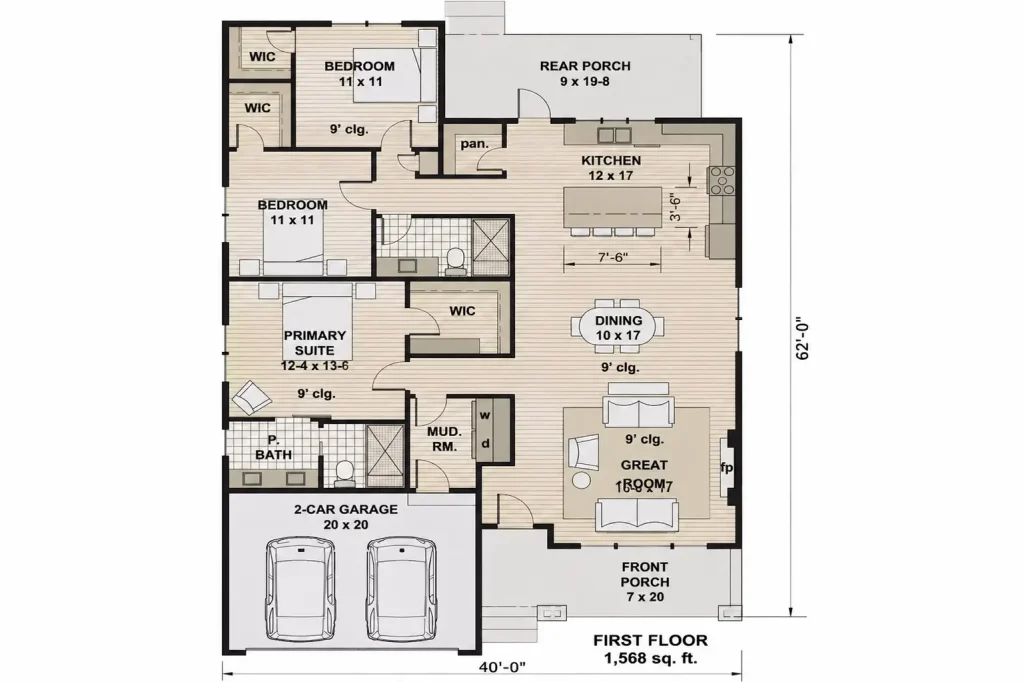
Before engaging a professional, you can do a meaningful self-assessment using publicly available tools.
Step 1 — Confirm zoning eligibility Go to your city or county’s official GIS or zoning portal. Search your address and confirm the zoning district. Most cities have online zoning maps. Check whether ADUs are permitted in your district.
Step 2 — Pull your parcel data Your county property appraiser or assessor website shows your lot dimensions, lot area, legal description, and often a survey plat. This tells you your actual lot size and approximate shape.
Step 3 — Apply setbacks to estimate buildable area Using your parcel dimensions and the applicable setbacks for ADUs in your jurisdiction (typically 4 ft rear and side in California under state law), draw a rough sketch of the buildable envelope. Does a 400–600 square foot structure fit?
Step 4 — Check your utility panel Your electrical panel label shows the service amperage. If it’s 100 amps, panel upgrade is likely needed. If it’s 200 amps, there may be room depending on existing loads.
Step 5 — Use our free ADU Feasibility Checker Our ADU Feasibility Checker walks through the key variables — lot size, setbacks, existing structures, utility factors — and gives you a preliminary read on whether your property is a likely ADU candidate.
When You Need a Professional ADU Feasibility Study
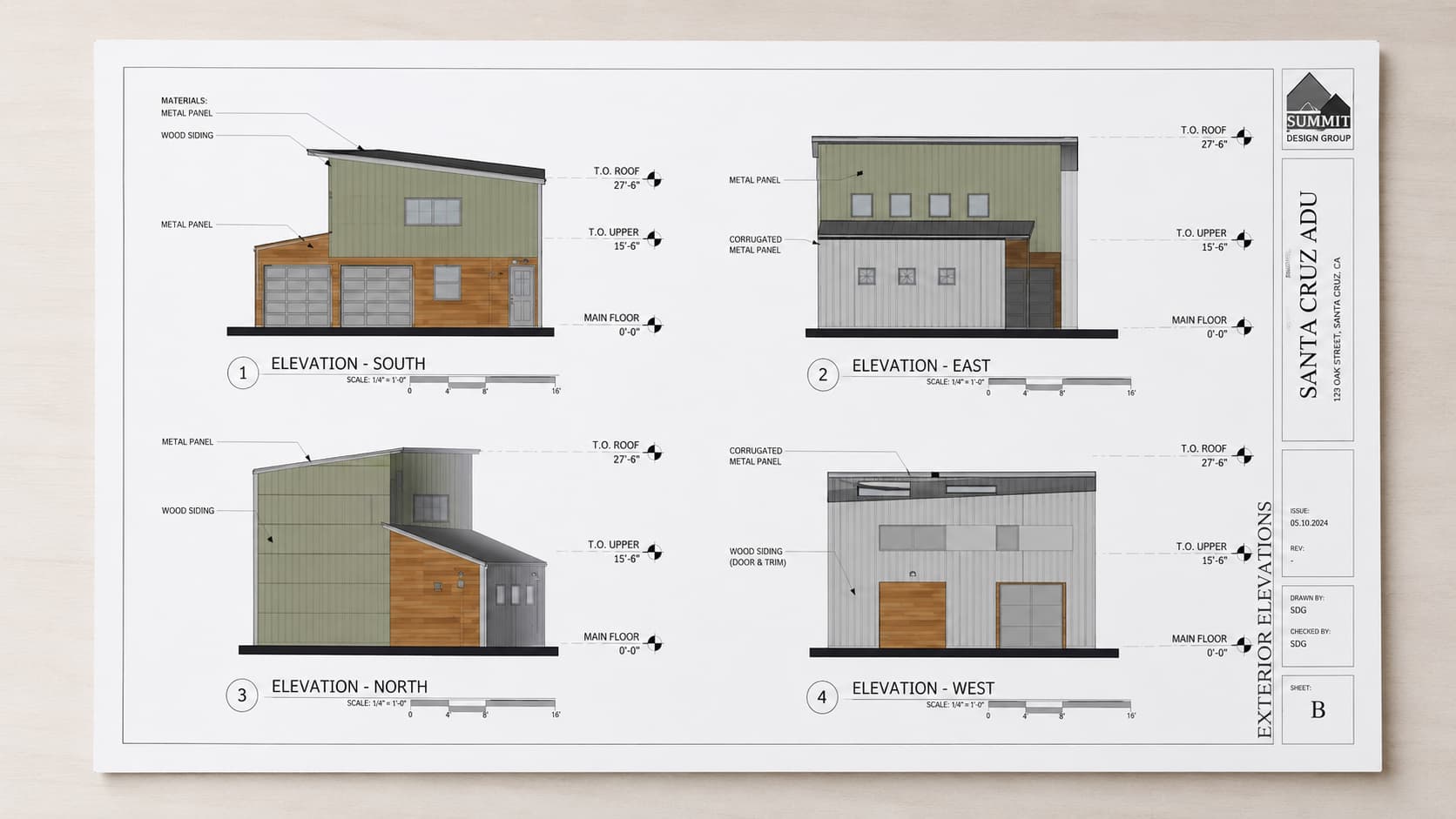
A self-assessment gives you a starting point. A professional study gives you certainty — and in some cases, it’s the only way to get a reliable answer.
When professional feasibility is worth it:
- Your lot is irregular, sloped, or has unusual site conditions
- There are easements, restrictions, or deed limitations you’re uncertain about
- You’re in a jurisdiction with complex overlay zones (coastal zones, hillside zones, historic districts)
- You’re evaluating whether to spend $200,000+ on construction — due diligence has clear value at that investment level
- Your utility situation is unclear and upgrading costs could significantly change the budget
For complex ADU projects, engaging in a preliminary review with local government departments during the feasibility study is particularly valuable when multiple site-specific factors exist, such as brush management zones, coastal zones, or bonus programs. Preliminary review meetings allow obtaining written feedback from city planners, providing clarity on potential hurdles and ensuring the approach aligns with their expectations.
What a professional study typically includes:
- Full zoning and land use analysis
- Site measurements and buildable envelope mapping
- Utility infrastructure assessment (sometimes including a licensed electrician or plumber consult)
- Easement and title review
- Permit timeline and fee estimate
- Preliminary financial analysis
- Written report with findings and recommendations
Cost of a professional ADU feasibility study: Professional ADU feasibility studies typically cost between $500 and $3,500 depending on scope and market. In high-cost cities like Los Angeles and San Francisco, fees tend to be higher. Some design-build contractors offer feasibility as part of their pre-construction services.
From Feasibility to Site Plan — The Next Step
Once your feasibility study confirms that an ADU is viable on your property, the next step is getting a permit-ready site plan prepared.
An ADU site plan shows:
- Your property boundaries with dimensions
- Existing house and all existing structures
- Proposed ADU location with all setbacks labeled
- Parking space location and dimensions (if required)
- Utility connections (water, sewer/septic, electrical)
- Lot coverage calculation
- Access route from street to ADU
The site plan is the primary document your building department uses to review your ADU permit application. It must be formatted for your specific jurisdiction, drawn to scale, and include all required elements.
At Site Plans Online USA, we prepare ADU site plans for homeowners across all 50 states. We work from your property address and feasibility findings to produce a permit-ready PDF within 24 to 48 hours.
For California and Florida ADU projects, we have specific knowledge of state ADU law requirements and local city standards.
- View ADU Plans for Permit
- ADU Site Plan Guide
- See our ADU Feasibility Checker
- Calculate your ADU site plan cost
ADU Feasibility by State — Key Differences
California: The strongest ADU regulatory environment in the US. State law overrides most local restrictions, sets maximum setbacks at 4 feet for detached ADUs, and prohibits owner-occupancy requirements. Impact fees waived for ADUs under 750 square feet. Most active ADU permit market nationally.
Texas: No statewide ADU reform law. ADU eligibility varies city by city and is heavily influenced by HOA covenants, which are widespread in Texas planned developments. Cities like Austin have progressive ADU ordinances; suburban areas tend to be more restrictive.
Florida: ADU rules vary county by county. No California-equivalent state preemption law, so local jurisdictions have more control. Some Florida counties are expanding ADU programs to address housing shortage. Florida-specific site plans available at Site Plans FL.
Washington and Oregon: Both states have passed ADU-friendly legislation in recent years. Oregon’s HB 2001 eliminated single-family zoning statewide, enabling ADUs broadly. Washington has similar momentum. Requirements still vary by city.
New York: ADU policy varies dramatically. New York City has specific ADU programs; upstate municipalities vary widely. Many older Northeast jurisdictions are still adapting to the ADU trend.
ADU Feasibility Checklist — 12 Questions to Ask Before You Build
Use these questions as your starting framework:
- Is my property in a zone where ADUs are permitted?
- Does my lot have sufficient area after setbacks to fit a usable ADU?
- Does lot coverage allow for an additional structure?
- Are there easements on my property that restrict placement?
- Is my electrical panel 200 amps or higher — or can it be upgraded affordably?
- Can my water and sewer service handle an additional dwelling unit?
- Does my HOA covenant permit ADU construction and rental?
- Am I in a historic district, coastal zone, or fire hazard severity zone?
- What is the local permitting timeline — and does my city offer pre-approved ADU plans?
- What are the impact fees for my ADU size?
- Is garage conversion or new construction more cost-effective for my property?
- Does the rental income projection support the construction cost within my financial timeframe?
Frequently Asked Questions About ADU Feasibility Studies
Do I need a professional feasibility study before building an ADU?
For straightforward properties in California with clear zoning eligibility, adequate lot size, and no unusual site conditions, a self-assessment using public tools and our ADU Feasibility Checker may be sufficient to confirm viability. For complex properties, unusual site conditions, or high investment amounts, a professional study provides certainty that self-assessment can’t replicate.
How long does an ADU feasibility study take?
A professional feasibility study typically takes 1 to 3 weeks depending on scope and whether site visits are required. Self-assessment using online tools can be completed in a few hours.
What’s the difference between an ADU feasibility study and an ADU site plan?
A feasibility study answers “can we build here and should we?” A site plan is the permit document that shows “here is where and how we will build.” The feasibility study typically comes first. The site plan is what you submit to the building department once you’ve decided to proceed.
Can I do an ADU feasibility study without an architect?
For basic properties, yes — zoning eligibility, setback analysis, and utility assessment can be done without an architect. For complex properties, or if the study is informing a $200,000+ investment decision, professional involvement is worth the cost.
Does an ADU feasibility study guarantee permit approval?
No. A feasibility study assesses likelihood based on current zoning and site conditions. It doesn’t constitute a permit pre-approval. Local building departments make final permit decisions.
What if the feasibility study says my property isn’t viable?
A no-go finding isn’t always final. The study may identify specific barriers (a setback that falls short by 2 feet, an electrical panel upgrade needed) that can be addressed. It may also suggest alternative ADU types — a JADU within the existing house, for example, when a detached ADU isn’t feasible.
Summary — What to Do Next
If you’re considering an ADU, the efficient path is:
- Use our free ADU Feasibility Checker — confirms basic zoning eligibility, lot capacity, and key variables for your property in minutes
- If it looks viable — move to a site plan. Our ADU Plans for Permit service prepares a permit-ready ADU site plan in 24 to 48 hours, formatted for your jurisdiction
- If your property has complex conditions — engage a local professional for a full feasibility study before investing in design
- For California and Florida properties — we have deep state-specific knowledge. Contact us with your address and project details
Related reading on siteplans.online:
- ADU Site Plan Guide
- ADU Plans for Permit — Service Page
- Residential Site Plans for Permits
- Site Plan for Permit — Complete Guide
- PE Stamp Services — for ADU projects requiring engineering review
- Site Plan Cost Calculator
- Florida ADU Permits — Site Plans FL
Take the Next Step With Confidence
Avoid unnecessary delays and prepare for your permit application with greater confidence. Use our free tools to review your project and understand the next steps before moving forward.
ADU Feasibility Checker
Check whether your property may be suitable for an accessory dwelling unit.
Check ADU Feasibility 02Site Plan Checker
Review your drawing for common missing details and potential submission issues.
Review Your Site Plan 03Permit Requirements Checker
Identify the likely permit requirements for your location and project type.
Check Requirements 04Site Plan Cost Calculator
Get a quick site plan cost estimate based on your project requirements.
Calculate Your CostGet Your Permit Drawing Scope Reviewed
Send us the property address and project details. We’ll help identify the likely drawing scope and next step.

Engineer Wasim
Civil/Structural Engineer and founder behind Site Plans Online USA. His permit-drafting experience dates back to 2015, supporting residential, commercial, structural and site-development projects.
Learn More About Site Plans LLC →