
You’re about to buy a house with a finished basement, or you’re planning an addition on a property you’ve owned for years, and one question keeps coming up: was any of this ever permitted? Skip that question and you risk inheriting someone else’s unpermitted work, along with the fines, forced teardowns, and stalled closings that come with it.
To find old building permits on your property, search your city or county’s online permit portal by street address, parcel number (APN), or owner name. If nothing turns up online, call the local building department directly — many older records exist only on microfiche or paper and require an in-person or public records request. Most US jurisdictions digitized permits sometime between 1995 and 2015, so anything before that window often lives in a physical archive rather than a searchable database.
The rest of this guide walks through exactly where to look, how to interpret what you find, and what to do when the paper trail runs cold.
Why Checking Permit History Matters Before You Buy or Build
A building permit is proof that work was reviewed, inspected, and approved by your local building department. No permit on file means no proof any of that happened, even if the finished product looks solid.
This shows up as a real problem in a few common situations:
- During a home purchase — an appraiser or inspector flags a finished basement, converted garage, or extra bathroom that doesn’t match the county’s records, and now the deal is delayed while everyone figures out what to do about it.
- During a sale — a seller who doesn’t disclose known unpermitted work can face legal exposure from the buyer after closing.
- During a renovation — building on top of, or tying new work into, an unpermitted structure often means the inspector requires you to bring the older work up to code first, which can double your project’s scope.
The Financial Risk of Skipping This Step
Retroactive permits typically cost more than pulling one up front, some jurisdictions charge double or triple the standard fee once work is caught after the fact. On top of that, you may be required to open finished walls or ceilings so an inspector can verify wiring, plumbing, or framing that was never checked the first time around.
For a buyer, that’s a renovation budget you didn’t plan for.
For a seller, it’s a price reduction or a deal that falls apart in escrow.
Where to Find Old Building Permits
1. Your City or County’s Online Permit Portal
This is the fastest starting point for most properties. Search “[city or county name] permit search” or look for a “Building Department” or “Permits” section on your local government’s website. Portals go by different names depending on the jurisdiction — common ones include “ePlans,” “permit lookup,” or “Citizens Access.”
Once you’re in, try searching by:
- Street address — the simplest option, though enter it in a stripped-down format (e.g., “451 State” instead of “451 South State Street”) since some systems don’t handle full addresses well.
- Parcel number (APN) — often more reliable for older properties, especially if the street address or numbering has changed over the decades.
- Owner name — useful when the property has changed hands multiple times and the address history is murky.
Coverage varies enormously by jurisdiction. Some cities have digital records going back to the 1980s; others only cover permits issued in the last 10–15 years.
2. The County Assessor’s Office
If the permit portal comes up empty, the county assessor or tax assessor’s office is worth a separate check. This office maintains property records tied to tax assessments, including square footage and room counts on file — which is a useful cross-check even if it doesn’t hand you the permit itself. If a listing claims 4 bedrooms but the assessor’s file shows 3, that extra room is a strong signal of unpermitted work.
3. In-Person or Public Records Requests for Older Files
Permits from the 1920s through the 1990s are frequently stored on microfiche or in paper archives at the building department, a town hall, or a local library. Many homes built before 1950 have no permit record at all, simply because permitting wasn’t universally required at the time.
If nothing shows up online, call the department before assuming no permit was ever issued — staff can often tell you within a few minutes whether older files exist and how to request them.
4. Annexed Properties: Check Both City and County Records
If a property was annexed into city limits within the last couple of decades, older permits may sit in the county’s system while newer ones are filed under the city. Search both, especially for properties near a city’s boundary.
What to Do If You Find Unpermitted Work
Finding a gap in the permit history isn’t automatically a dealbreaker, but it does change your next move.
- Get a professional opinion first. A licensed contractor or inspector can tell you whether the unpermitted work appears structurally sound, which affects how urgently it needs to be addressed.
- Ask the building department what retroactive permitting involves. Some jurisdictions will let you file for the permit after the fact with an inspection; others may require partial demolition to verify what’s behind the walls.
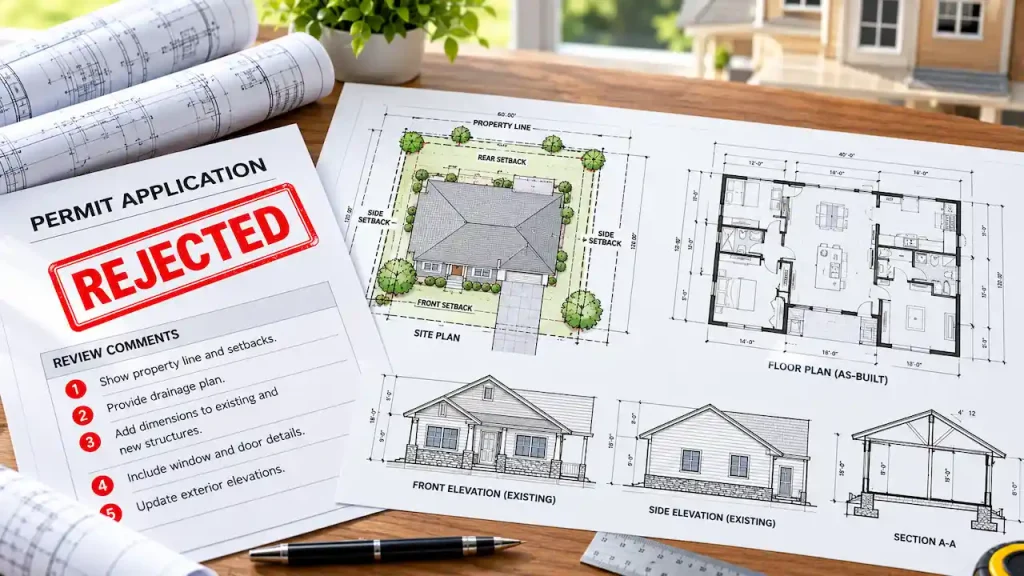
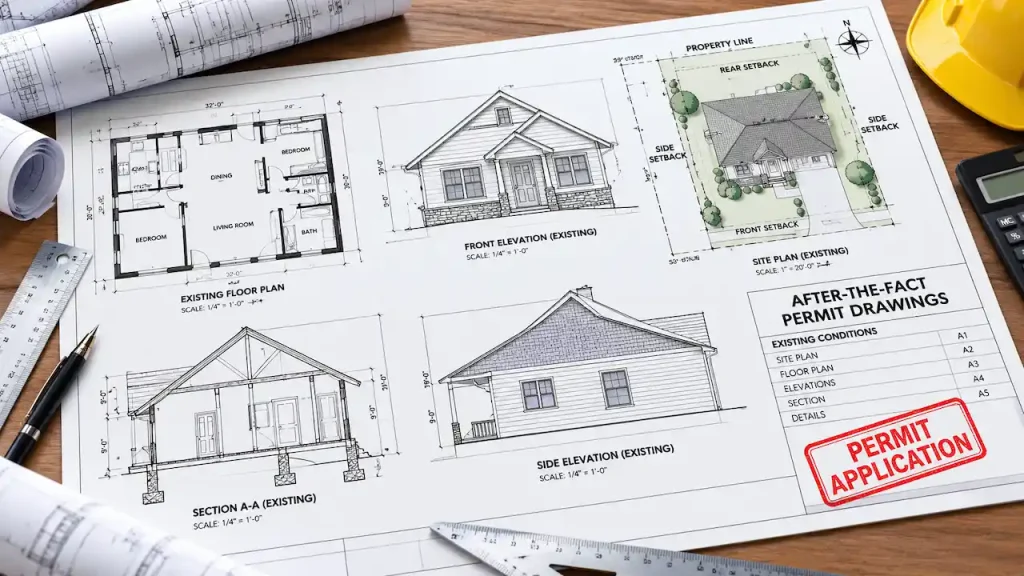
- Loop in a site plan or drafting professional if the addition affected the building’s footprint. A retroactive permit for an addition, converted garage, or ADU almost always requires an updated site plan showing the structure’s location relative to property lines and setbacks, which is exactly the kind of document a residential site plan service prepares for submission.
If the retroactive permit review turns into a back-and-forth with the building department, having your paperwork rejected-proof the first time matters — running a proposed plan through a permit rejection analyzer before submission can catch the same issues a reviewer would flag.
Before You Start New Work, Check Requirements First
If your permit history search turns up clean, or once you’ve resolved a gap, don’t assume your next project is automatically exempt from a full review. Requirements shift by jurisdiction and by project type, so it’s worth confirming what your specific build will trigger before you start drafting anything.
A permit requirements checker is a fast way to see what your city or county will ask for based on your project type and location, before you invest time in a design that doesn’t match local rules.
For additions, ADUs, or any project involving structural changes, expect the building department to eventually ask for a stamped, scaled site plan for your permit application rather than a hand sketch, regardless of what the original, unpermitted structure looked like.
Conclusion
Finding old building permits comes down to three checkpoints: your local permit portal, the county assessor’s office, and a direct call to the building department for anything older than 20-30 years. Doing this search before you buy, sell, or renovate turns a potential surprise into a manageable line item, whether that means a quick confirmation that everything’s on record or a clear plan for retroactively permitting work that isn’t. Either way, you’re in a far better position than finding out mid-escrow or mid-renovation.
FAQs
1. Do I need to own the property to look up its building permits?
No. Building permits are public records in nearly all US jurisdictions. Most online portals let you search by address without creating an account or proving ownership, and in-person requests work the same way, though staff may ask for contact information to send you results.
2. How far back do online permit records usually go?
It varies widely by city and county, but most jurisdictions digitized their records sometime between 1995 and 2015. Anything issued before that window is often only available on microfiche or paper in a physical archive, which usually means an in-person visit or a public records request.
3. What if my home was built before permits were commonly required?
Homes built before 1950 frequently have no permit record at all, since permitting wasn’t universal at the time. In that case, the absence of a permit isn’t necessarily a red flag on its own — it’s worth confirming with the building department rather than assuming the work was done improperly.
4. Can I find permits under an old address if the street was renumbered?
Yes, this is a common issue with older properties. If a street address search comes up empty, try the parcel number (APN) instead, since it stays consistent even when addresses change, or search by a previous owner’s name if you know it.
5. My permit history search shows a gap — does that mean I can’t sell or buy the property?
Not necessarily. A missing permit means the work wasn’t documented, not that it can’t be fixed. Many buyers and sellers work through retroactive permitting or negotiate the cost of bringing the work up to code as part of the transaction, rather than walking away entirely.
6. Is a permit search different from a title search?
Yes. A title search confirms legal ownership and liens on a property, while a permit search confirms whether construction work was reviewed and approved by the building department. Buyers doing full due diligence typically need both, since one doesn’t substitute for the other.
Take the Next Step With Confidence
Avoid unnecessary delays and prepare for your permit application with greater confidence. Use our free tools to review your project and understand the next steps before moving forward.
ADU Feasibility Checker
Check whether your property may be suitable for an accessory dwelling unit.
Check ADU Feasibility 02Site Plan Checker
Review your drawing for common missing details and potential submission issues.
Review Your Site Plan 03Permit Requirements Checker
Identify the likely permit requirements for your location and project type.
Check Requirements 04Site Plan Cost Calculator
Get a quick site plan cost estimate based on your project requirements.
Calculate Your CostGet Your Permit Drawing Scope Reviewed
Send us the property address and project details. We’ll help identify the likely drawing scope and next step.

Engineer Wasim
Civil/Structural Engineer and founder behind Site Plans Online USA. His permit-drafting experience dates back to 2015, supporting residential, commercial, structural and site-development projects.
Learn More About Site Plans LLC →