
Most residential permit applications require a site plan. A smaller number also require a separate landscaping site plan or landscape plan. Understanding when each is needed — and what the landscape plan must include when required — saves you a correction notice and a delay.
If you are prepping your core layout documents, checking our universal Site Plan for Permit guide will ensure you have your baseline zoning elements covered.
I’m Engineer Wasim of Site Plans Online USA. This is the complete guide.
What Is a Landscaping Site Plan?

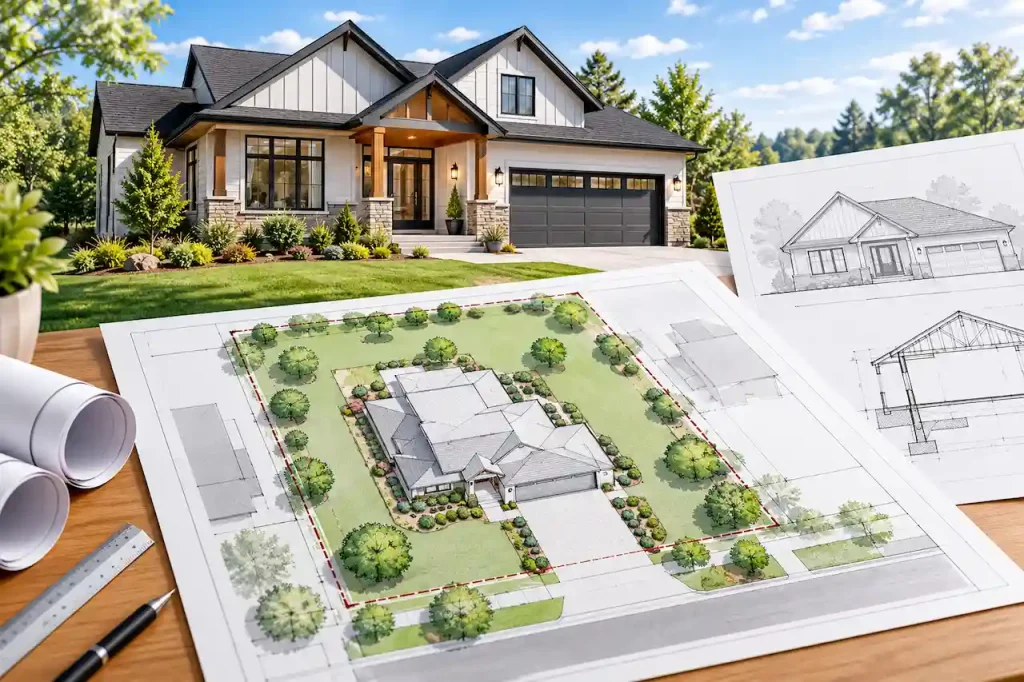
A landscaping site plan (also called a landscape plan or planting plan) is a drawing that shows the placement, species, and specifications of plants, trees, and landscape features on a property.
It’s distinct from a standard permit site plan:
- Standard site plan — shows structures, setbacks, lot boundaries, and proposed construction. Property-level view for permit review.
- Landscaping site plan — shows plant material, irrigation, ground cover, trees, and landscape buffers. Required when the permit evaluates landscaping compliance.
To explore how these technical formatting differences look in practice, check out our deep-dive breakdown: What Is a Landscaping Site Plan.
When Is a Landscaping Site Plan Required?
Always Required For:
Commercial permits in most jurisdictions: Most cities require a landscape plan as part of the commercial building permit application. Requirements typically specify:
- Percentage of lot area that must be landscaped
- Buffer zones between parking and streets
- Buffer zones between commercial and residential uses
- Shade tree requirements in parking areas (1 tree per 8–10 spaces is common)
- Species selection requirements (native or drought-tolerant in many Western states)
Our dedicated Commercial Site Plans for Permits toolkit details these exact constraints, which typically specify the percentage of lot area that must be landscaped, buffer zones between parking and streets, shade tree counts, and native or drought-tolerant species mandates.
New home construction in many jurisdictions: Some cities require a landscape plan showing how the property will be planted and irrigated as part of the final permit approval. This is common in regions like the California Site Plan Guide footprint, as well as our Arizona Site Plans and Colorado Site Plans networks, where severe water conservation is an active municipal policy priority.
Conditional Use Permit applications: Planning commissions often condition approval of commercial projects on landscape plans showing screening, buffering, and site beautification. You can see how these requirements tie directly into broader planning approvals via our Conditional Use Permit Guide.
Sometimes Required For:
Large residential additions: Some jurisdictions require a landscape plan update if the addition significantly changes the site’s impervious surface or grading.
ADU projects: Some California cities require a landscape plan showing that the ADU lot will be appropriately planted and irrigated.
Hillside grading projects: Grading permits in hillside areas often require a revegetation/landscape plan showing how disturbed slopes will be replanted.
Usually NOT Required For:
Most standard residential permits — pools, fences, sheds, decks, basic additions, garages, driveways — don’t require a separate landscape plan. The standard site plan is sufficient.
When in doubt, check your permit checklist. Use our Permit Requirements Checker.
What a Commercial Landscaping Site Plan Must Include

For commercial permits requiring a landscape plan:
- Plant legend — listing all plant species shown on the plan, with botanical name, common name, container size, and spacing
- Planting plan — locations of all trees, shrubs, ground cover, and turf areas shown on the scaled site plan
- Landscape buffer dimensions — width of planting buffers labeled from the property line or parking edge
- Parking lot shade trees — trees shown within parking islands with species labeled
- Irrigation system notation — statement confirming drip or low-volume irrigation for planted areas (required in many Western states)
- Water conservation calculation — some jurisdictions require a MWELO (Model Water Efficient Landscape Ordinance) worksheet (California)
- Scale, north arrow, title block
California MWELO — Landscape Water Use Requirements
California’s Model Water Efficient Landscape Ordinance (MWELO) applies to:
- New construction projects over 500 sq ft of landscape area
- Rehabilitated landscapes over 2,500 sq ft
Projects subject to MWELO must prepare a Landscape Documentation Package, which includes a landscape design plan, irrigation design plan, and water budget calculation.
For California commercial and large residential projects, the landscape plan is not optional — it’s a required permit document.
How Our Landscaping Site Plans Are Prepared
For projects requiring a landscape plan alongside the standard site plan, we prepare both documents as part of the permit package. The landscape plan is formatted to match your building department’s requirements, coordinate with the site plan scale and orientation, and include all required plant legend and buffer information.
Select an option below to get your standard or landscaping plans drafted by our engineering team:
Take the Next Step With Confidence
Avoid unnecessary delays and prepare for your permit application with greater confidence. Use our free tools to review your project and understand the next steps before moving forward.
ADU Feasibility Checker
Check whether your property may be suitable for an accessory dwelling unit.
Check ADU Feasibility 02Site Plan Checker
Review your drawing for common missing details and potential submission issues.
Review Your Site Plan 03Permit Requirements Checker
Identify the likely permit requirements for your location and project type.
Check Requirements 04Site Plan Cost Calculator
Get a quick site plan cost estimate based on your project requirements.
Calculate Your CostGet Your Permit Drawing Scope Reviewed
Send us the property address and project details. We’ll help identify the likely drawing scope and next step.

Engineer Wasim
Civil/Structural Engineer and founder behind Site Plans Online USA. His permit-drafting experience dates back to 2015, supporting residential, commercial, structural and site-development projects.
Learn More About Site Plans LLC →