
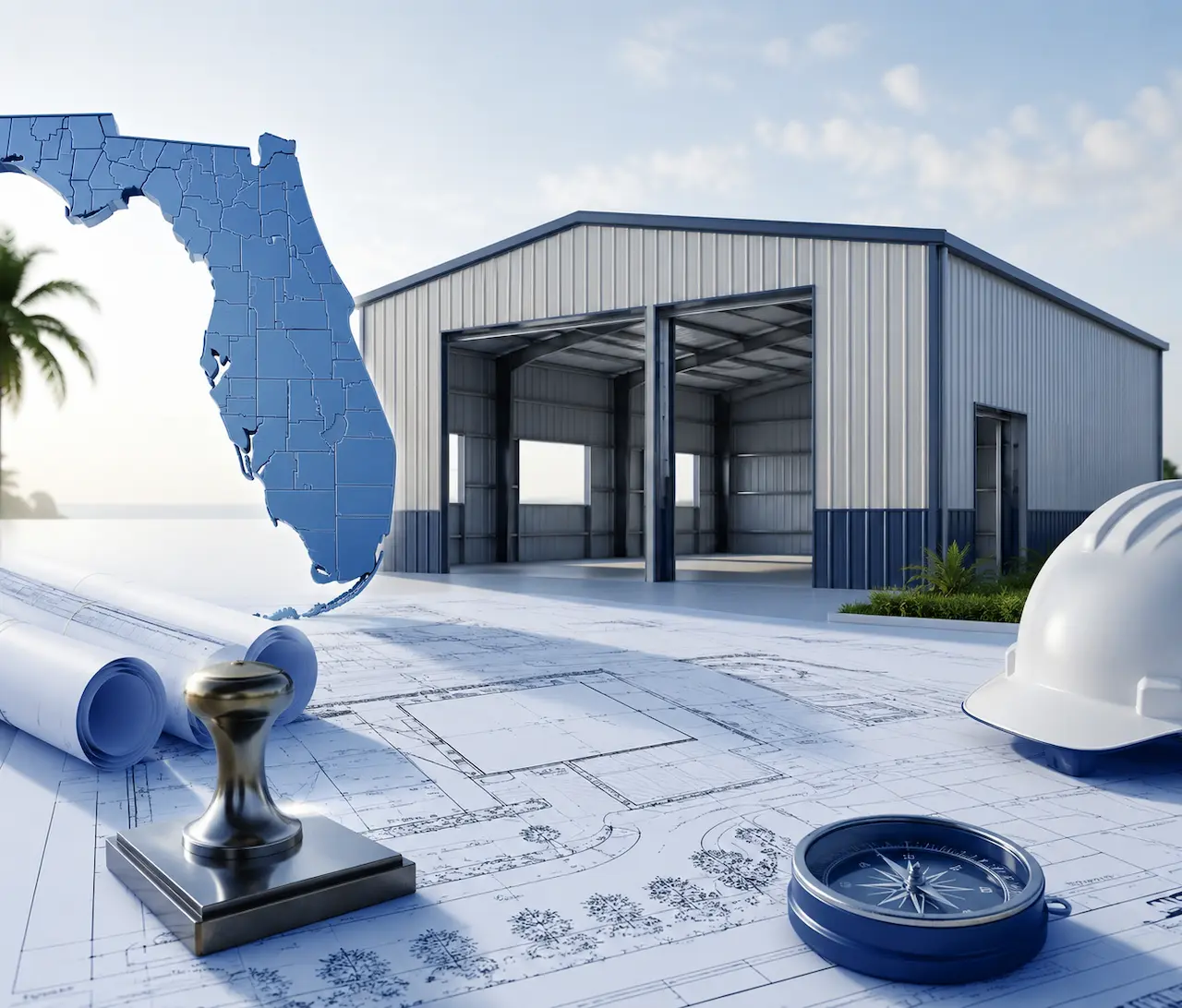
You ordered the metal building kit. The delivery date is set. Then your contractor tells you the permit process takes 8 weeks and you need a Florida-licensed PE to stamp the drawings, Florida Product Approval numbers for every component, and a site plan that shows wind load compliance notation.
Nobody told you any of this before you placed the order.
<cite index=”11-1″>Metal building permit requirements catch thousands of buyers off guard every year. You have ordered your steel building kit, the delivery date is set, and then your contractor tells you the permit takes 8 weeks. That delay costs real money in crew scheduling, concrete finishing, and equipment rental.</cite>
I’m Engineer Wasim, founder of Site Plans Online USA. We prepare metal building permit site plans across all 67 Florida counties. This guide covers everything wind zones, NOA certification, PE stamp requirements, Florida HB 803 changes, and exactly what your site plan must include for your specific county.
Why Florida Has the Strictest Metal Building Permit Requirements in the United States
<cite index=”11-1″>Florida has the strictest permitting in the country. All buildings require permits. Wind-load engineering is mandatory and more stringent than IBC minimums in coastal counties.</cite>
The reason goes back to Hurricane Andrew, which made landfall in Miami-Dade in August 1992 and caused $27 billion in damage — the costliest hurricane in US history at that point. The Florida Building Code that emerged from Andrew’s aftermath is updated on a three-year cycle and has no local opt-out provision. Every county. Every structure. Same minimum wind standard.
These statewide requirements also affect how Florida site plans must document the proposed structure, property conditions and applicable permit information.
<cite index=”24-1″>Florida’s 8th Edition adopted ASCE 7-22, the latest wind load standard from the American Society of Civil Engineers. This brought updated wind speed maps, revised exposure categories, and more precise calculations for how buildings must resist hurricane-force winds.</cite>
This matters for your metal building permit in two ways:
- The Florida Building Code 8th Edition (currently in effect) requires more precise wind calculations than the previous edition — meaning your engineering package must reference ASCE 7-22 specifically
- <cite index=”24-1″>Coastal A-Zone and V-Zone construction standards are more specific about foundation design, breakaway wall requirements, and utility placement. Projects in Special Flood Hazard Areas (SFHAs) face additional scrutiny during plan review.</cite>
What Florida HB 803 Changes for 2026
Florida House Bill 803, signed into law May 7, 2026 and effective July 1, 2026, makes one important change relevant to metal building projects:
<cite index=”13-1″>HB 803 exempts certain residential construction work valued under $7,500 from building permit requirements, effective July 1, 2026.</cite> However, this exemption does not apply to metal buildings, structural work, or commercial structures. A metal building — regardless of size — does not qualify for the HB 803 exemption. You still need a full permit.
What HB 803 does change: <cite index=”13-1″>the bill accelerates the issuance of building permits by limiting local building department oversight and discretion and expanding the role and autonomy of private providers.</cite> In practice, this means faster review timelines may become available in some counties by the end of 2026 as private provider programs expand.
Florida’s Three Wind Zones — Which One Is Your Project In?
Where you build in Florida determines your design wind speed, which determines your engineering requirements, which determines your site plan notation. These are not interchangeable.
| Wind Zone | Counties Included | Design Wind Speed | Code Standard | Key Permit Impact |
|---|---|---|---|---|
| Standard Inland | Marion (Ocala), Alachua (Gainesville), Polk (Lakeland interior), Columbia, Suwannee, Hamilton, Madison, Taylor | 110–130 mph | Florida Building Code | Standard PE stamp + FPA numbers |
| Coastal | Sarasota, Charlotte, Manatee, Lee, Collier, Monroe (Keys), Volusia, Flagler, Nassau, Duval coast, St. Johns, Indian River, Okeechobee, Highlands, Glades, Hardee, DeSoto, Hendry | 130–150 mph | Florida Building Code Enhanced | Higher-rated framing + coastal engineering |
| HVHZ | Miami-Dade and Broward only | 175–185+ mph | High-Velocity Hurricane Zone Code | NOA certification required for all components |
Your specific design wind speed is determined by the Florida Building Code wind speed maps (based on ASCE 7-22), and it can vary within a county depending on distance from the coastline and local terrain exposure category. A Florida-licensed PE determines your exact site speed as part of the engineering package.
The NOA Requirement — The Most Misunderstood Florida Permit Rule
<cite index=”23-1″>Wind product approval documentation: NOA certificates in HVHZ counties, Florida Product Approval numbers elsewhere</cite> must accompany every Florida metal building permit application.
NOA (Notice of Acceptance) is product certification issued specifically by Miami-Dade County for construction products used in HVHZ buildings — Miami-Dade and Broward only.
Florida Product Approval (FPA) is the statewide equivalent — required everywhere in Florida outside HVHZ.
These are not the same document. An FPA number is not sufficient for HVHZ. An NOA is required for Miami-Dade and Broward.
For a metal building, these approvals apply to individual components — not the building as a whole:
| Component | Approval Required (Non-HVHZ) | Approval Required (HVHZ) |
|---|---|---|
| Wall panels | Florida Product Approval | Miami-Dade NOA |
| Roof panels | Florida Product Approval | Miami-Dade NOA |
| Fasteners | Florida Product Approval | Miami-Dade NOA |
| Doors | Florida Product Approval | Miami-Dade NOA |
| Windows / openings | Florida Product Approval | Miami-Dade NOA |
| Skylights | Florida Product Approval | Miami-Dade NOA |
The critical buyer warning: <cite index=”19-1″>most national metal building companies do not offer NOA-certified kits. They can design and fabricate a building, but they haven’t invested in testing their specific product line through Miami-Dade’s approval process. If you’re in Miami-Dade or Broward, you must verify NOA certification before you request a quote or pay a deposit.</cite>
If a manufacturer cannot provide specific NOA certificate numbers for wall panels, roof panels, and fasteners, they cannot legally supply materials for your HVHZ project.
What the Florida Metal Building Permit Package Must Include
<cite index=”22-1″>Applying for a metal building permit involves several important steps:</cite>
| Document | Who Prepares It | Required For |
|---|---|---|
| Site plan | Licensed drafter or engineer | All permits — shows setbacks, location, property lines |
| PE-stamped engineering drawings | Florida-licensed PE only | All metal building permits statewide |
| Foundation plan | PE or structural engineer | All permanent structures |
| Wind load certification | Florida-licensed PE | All metal building permits |
| Florida Product Approval numbers | Manufacturer | Non-HVHZ counties |
| NOA certificates | Manufacturer | Miami-Dade and Broward only |
| Energy compliance documentation | PE or energy consultant | All conditioned space |
| FEMA flood zone certificate | Surveyor or PE | Properties in flood zones |
| Owner-Builder form or contractor license | Applicant | All permits |
<cite index=”20-1″>PE-stamped drawings must be certified by an engineer licensed in your specific state.</cite> Out-of-state PE stamps are not accepted anywhere in Florida. This is the most common error we see on metal building permit applications from buyers who worked with national kit companies.
The Site Plan: What Every Florida Metal Building Permit Requires
The site plan is the foundational document for every metal building permit in Florida. Without it, the application cannot be accepted. Here is exactly what yours must show:
Property and Location Elements
- Property boundaries with dimensions in feet
- Street name and property address
- Parcel identification number
- North arrow
- Scale bar (e.g., 1 inch = 40 feet for larger parcels)
- Drawing scale noted in title block
Existing Site Conditions
- Main house or existing structures (fully dimensioned)
- All existing accessory structures
- Driveway and parking areas
- Utility easements and drainage easements noted
- Any existing fencing
Proposed Metal Building
- Metal building footprint with dimensions (length × width)
- Setback to rear property line — dimension labeled in feet
- Setback to each side property line — dimension labeled
- Setback to front property line — dimension labeled
- Door and opening locations (bay doors, entry doors, windows)
- Equipment pad or utility connection location if applicable
- Drainage direction from the structure noted
Florida-Specific Notation
- Wind speed zone for the property location (e.g., “Design Wind Speed: 140 mph, Exposure Category C”)
- Flood zone designation for flood zone properties (AE, VE, X, etc.)
- Base Flood Elevation if applicable
- HVHZ notation for Miami-Dade and Broward projects: “This project is located within the High Velocity Hurricane Zone per Florida Building Code”
- Coastal Construction Control Line notation for properties seaward of the CCCL
Impervious Surface Calculation
Most Florida counties limit the total percentage of a lot that can be covered by hard surfaces. A metal building and its concrete slab both count. Your site plan must show:
- Existing impervious surface (sq ft and % of lot)
- Proposed metal building + slab addition (sq ft)
- New total impervious surface (sq ft and %)
- Maximum allowed per zoning code
Florida Metal Building Setback Requirements by County
Setbacks for accessory structures (including most metal buildings on residential lots) are measured from the nearest wall of the structure to the property line.
| County / Area | Front Setback | Rear Setback | Side Setback | Commercial Notes |
|---|---|---|---|---|
| Miami-Dade (residential) | 25 ft | 25 ft | 7.5 ft | HVHZ — all components need NOA |
| Broward (residential) | 25 ft | 25 ft | 7.5 ft | HVHZ — all components need NOA |
| Palm Beach County | 25 ft | 25 ft | 7.5 ft | ePZB portal |
| Hillsborough (residential) | 25 ft | 25 ft | 7.5 ft | City of Tampa vs county portal |
| Orange County | 25 ft | 25 ft | 7.5 ft | FastTrack portal — file name critical |
| Lee County | 25 ft | 25 ft | 7.5 ft | Agricultural: lesser setbacks may apply |
| Collier / Naples | 25 ft | 25 ft | 7.5 ft | City of Naples separate from county |
| Sarasota County | 25 ft | 25 ft | 7.5 ft | Coastal setbacks on barrier islands |
| Pasco County | 25 ft | 20 ft | 7.5 ft | Active garage/shop market |
| Marion County (Ocala) | 25 ft | 25 ft | 7.5 ft | Agricultural lots — verify AG zoning rules |
| Alachua (Gainesville) | 25 ft | 25 ft | 7.5 ft | University market — ADU + workshop demand |
| Leon (Tallahassee) | 25 ft | 20 ft | 7.5 ft | TLC Permits portal |
| Escambia (Pensacola) | 25 ft | 20 ft | 7.5 ft | Wind Borne Debris Region (not HVHZ) |
| Polk County (Lakeland) | 25 ft | 25 ft | 7.5 ft | Active agricultural + commercial market |
| St. Lucie (Port St. Lucie) | 25 ft | 25 ft | 7.5 ft | EnerGov portal |
Commercial metal buildings follow different setback rules governed by the county’s commercial zoning code, fire codes (fire lane width, separation from adjacent structures), and ADA compliance requirements. We verify your specific parcel’s zoning designation before drawing begins.
Agricultural exemptions: Florida Statute 604.50 provides limited exemptions for agricultural structures on bona fide agricultural land. These exemptions are narrower than most buyers assume. <cite index=”20-1″>Agricultural exemptions are narrower than most buyers assume so always confirm eligibility</cite> with your county’s agricultural extension office before relying on one.
Metal Building Permit Timeline by Florida County
<cite index=”20-1″>Permit timelines range from 1 week in rural counties to 20+ weeks in California and Florida coastal areas.</cite> For Florida specifically:
| County Type | Typical Review Timeline | Portal | Notes |
|---|---|---|---|
| Standard inland counties | 3–6 weeks | Varies by county | Marion, Alachua, Polk, Lake, Sumter |
| Coastal counties | 4–8 weeks | Varies | Sarasota, Lee, Charlotte, Volusia |
| Orange County (Orlando) | 2–4 weeks | FastTrack | File naming critical — wrong name = intake rejection |
| Hillsborough (Tampa) | 3–6 weeks | City + County separate | Verify jurisdiction before submitting |
| Palm Beach County | 3–6 weeks | ePZB | 3 separate jurisdictions — check parcel |
| Miami-Dade (HVHZ) | 8–14 weeks | BDFD | Full HVHZ review of NOA and wind calculations |
| Broward (HVHZ) | 8–14 weeks | Broward County | HVHZ review + local municipal review |
| Keys / Monroe County | 10–16 weeks | Monroe County | Coastal regulations + flood zone + CCCL |
The HVHZ review is longer because Miami-Dade’s Building Department runs a separate, detailed review of wind load calculations and product approval documentation. <cite index=”19-1″>The HVHZ timeline is longer because Miami-Dade’s Building Department runs a more extensive review for wind load calculations and product approval documentation. Plan your project schedule around this, especially if you’re targeting a specific occupancy date.</cite>
PE Stamp — Mandatory for Every Florida Metal Building Permit
<cite index=”22-1″>FL-engineered plans stamped by a licensed engineer</cite> are required for every permanent metal building permit in Florida, residential or commercial, in all 67 counties.
This is non-negotiable and frequently misunderstood. There is no size threshold below which a metal building is exempt from PE stamp in Florida. A 10×12 storage shed may be exempt (under certain county-specific rules), but a permanent metal building with a concrete foundation is not.
What the PE stamp includes:
| Element | Detail |
|---|---|
| PE’s original signature | Wet or electronic — both accepted by Florida portals |
| FBPE seal | Florida Board of Professional Engineers registered seal |
| FBPE registration number | Must appear on all stamped sheets |
| Date | Date of review and signature |
| Wind load compliance statement | Confirming design meets Florida Building Code |
Florida PE license requirement: <cite index=”19-1″>Out-of-state PEs are not accepted on Florida building permit applications.</cite> The PE who stamps your drawings must hold an active Florida license registered with the FBPE. Florida PE licenses expire annually on February 28.
We coordinate Florida-licensed PE review and stamp for all metal building permit packages.
→ PE Stamp Services — Florida Licensed PE
Foundation Requirements — What the Site Plan Must Reference
<cite index=”22-1″>Foundation plan with anchoring details</cite> must accompany the site plan for every Florida metal building permit.
Florida foundation requirements for metal buildings are driven by three factors:
1. Wind uplift loads Florida’s wind speeds create significant uplift forces on metal buildings. Anchor bolt specifications (diameter, embedment depth, spacing) must be engineered for your specific wind zone.
2. FEMA Flood Zone <cite index=”22-1″>FEMA flood zone certificate (if applicable).</cite> If your parcel is in an AE or VE flood zone:
- Finished floor elevation must be at or above the Base Flood Elevation (BFE)
- AE zones may require elevated slab or stem wall
- VE (Velocity) zones require additional breakaway wall provisions
- Foundation costs in flood zones can run 40–80% higher than standard
3. Soil conditions Florida’s variable soils — expansive clays in some areas, loose sand in others, high water tables near the coasts — affect anchor design. Some counties require a geotechnical report for buildings over a certain size.
Standard foundation types by project:
| Project Type | Foundation Type | Notes |
|---|---|---|
| Residential garage / shop (Zone X) | 4–6 inch slab with thickened edge | Standard. 6-inch for commercial shop use |
| Agricultural storage building | Depends on county — some allow piers | Verify with county zoning before ordering |
| Coastal zone (AE flood zone) | Stem wall or elevated slab above BFE | BFE + 1 ft freeboard recommended |
| HVHZ (Miami-Dade / Broward) | Engineered slab with HVHZ anchor bolt spacing | Anchor bolt requirements are stricter |
Metal Building Permits Across All 67 Florida Counties — City-by-City Links
We prepare metal building permit site plans for all 67 Florida counties. The most active markets:
Southeast Florida (HVHZ):
→ Miami Metal Building Permit — Miami-Dade, HVHZ, NOA required
→ Fort Lauderdale Metal Building Permit — Broward, HVHZ, NOA required
→ West Palm Beach Metal Building — Palm Beach, ePZB portal
→ Hialeah Metal Building — Miami-Dade, HVHZ
Southwest Florida:
→ Fort Myers Metal Building — Lee County, coastal wind zone
→ Cape Coral Metal Building — Lee County, canal lots
→ Naples Metal Building — Collier County
→ Sarasota Metal Building — Sarasota County, Accela portal
→ Bradenton Metal Building — Manatee County
Tampa Bay:
→ Tampa Metal Building Permit — Hillsborough County
→ St. Petersburg Metal Building — Pinellas County
→ Clearwater Metal Building — Pinellas County coastal
→ Lakeland Metal Building — Polk County
Central Florida:
→ Orlando Metal Building — Orange County FastTrack
→ Port St. Lucie Metal Building — St. Lucie County, EnerGov
North Florida / Panhandle:
→ Jacksonville Metal Building — Duval County
→ Tallahassee Metal Building — Leon County
→ Pensacola Metal Building — Escambia County (Wind Borne Debris Region — not HVHZ)
→ Gainesville Metal Building — Alachua County
→ Pembroke Pines Metal Building — Broward County, HVHZ
What Competitors Don’t Cover — Where This Guide Goes Further
Most metal building permit guides — including the otherwise solid content from SteelBuildingKit.com and ProbuiltSteel — focus on construction costs and kit specifications. They underserve buyers on three things we see matter most in actual permit submissions:
1. Portal-specific formatting Orange County FastTrack rejects applications at intake if the file name is wrong — before a reviewer opens them. Broward County’s permit portal has different document naming conventions than Miami-Dade’s BDFD system. The right content in the wrong format costs you 2–4 weeks.
2. The site plan’s wind notation Most guides say “PE stamp required.” Almost none specify that the site plan itself must include wind speed notation — not just the engineering drawings. Building department intake checkers look at the site plan first. If the wind zone is missing from the site plan, the application gets a comment even if the engineering drawings are perfect.
3. F.S. 553.792 — The 10-Day Correction Deadline Once any Florida building department issues a correction notice, you have 10 business days to respond under Florida Statute 553.792. Miss that deadline and the application may be denied — requiring full restart and new fees. We turn corrections around within 24 hours. Your metal building permit timeline is controllable if you have a responsive plan preparer.
Pricing and Turnaround for Metal Building Permit Site Plans
| Service | Price | Delivery |
|---|---|---|
| Metal building permit site plan (standard) | From $199 | 24–48 hours |
| Full permit drawing set (site plan + structural + MEP) | From $1,199 | 4–7 business days |
| PE stamp on existing drawings | From $299 | 2–5 business days |
| Complete package: drawings + PE stamp | From $1,499 | 5–7 business days |
| Rush / same-day site plan | +$75 | Same business day |
→ Full Permit Drawing Set — Metal Buildings Florida
Every metal building site plan includes:
- GIS parcel pull and property line verification
- Wind zone determination for your specific address
- Flood zone check via FEMA FIRM maps
- Setback verification for your zoning district
- Wind speed notation appropriate to your county
- County portal formatting and file naming
- Free revisions within 24 hours if the building department requests changes
→ Non-Certified Site Plans — From $79
10 Frequently Asked Questions — Metal Building Permits in Florida
Q1: Does every metal building in Florida require a building permit?
Yes. <cite index=”22-1″>Florida’s building code requires permits and inspections for all steel buildings.</cite> The Florida Building Code applies statewide with no local opt-out provision. Every enclosed permanent metal structure requires a permit, regardless of size, in all 67 counties. The HB 803 exemption (effective July 1, 2026) for residential work under $7,500 does not apply to metal buildings or structural construction.
Q2: Does my metal building permit require a PE stamp in Florida?
Yes — always. <cite index=”22-1″>FL-engineered plans stamped by a licensed engineer</cite> are required for every metal building permit in Florida. There is no size threshold that exempts a permanent metal building from PE stamp. The PE must hold an active Florida license registered with the FBPE. Out-of-state PE stamps are not accepted.
Q3: What is the difference between Florida Product Approval and NOA?
Florida Product Approval (FPA) is the statewide product certification system. It is required for all metal building components throughout Florida. NOA (Notice of Acceptance) is a more stringent certification issued specifically by Miami-Dade County and is required for all components used in HVHZ counties (Miami-Dade and Broward). An FPA number is not sufficient for HVHZ — NOA is required.
Q4: What wind speed must my Florida metal building be designed for?
It depends on your location. Inland Florida counties generally require 110–130 mph design wind speed. Coastal counties require 130–150 mph. Miami-Dade and Broward (HVHZ) require 175–185+ mph. Your specific design wind speed comes from the Florida Building Code wind speed maps (ASCE 7-22). A Florida-licensed PE determines your exact site speed.
Q5: What is HVHZ and does it apply to my project?
HVHZ (High-Velocity Hurricane Zone) is a building code designation that applies exclusively to Miami-Dade and Broward counties. It is the strictest building code in the United States for wind resistance. If your project is in either of those two counties, HVHZ applies. Every component needs Miami-Dade NOA certification. All metal building kits must be specifically designed and tested to HVHZ standards.
Q6: What must a Florida metal building site plan include?
At minimum: property boundaries with dimensions, north arrow, scale bar, all existing structures, proposed metal building footprint with dimensions, all setback distances labeled in feet, wind speed zone notation, flood zone designation if applicable, HVHZ notation for Miami-Dade and Broward, and impervious surface calculation. County portal formatting requirements vary — Orange County FastTrack has specific file naming conventions, for example.
Q7: How long does a Florida metal building permit take?
<cite index=”19-1″>The HVHZ timeline is longer because Miami-Dade’s Building Department runs a more extensive review for wind load calculations and product approval documentation.</cite> Standard inland counties: 3–6 weeks. Coastal counties: 4–8 weeks. Miami-Dade and Broward: 8–14 weeks. Monroe County (Florida Keys): 10–16 weeks.
Q8: Is my metal building exempt if it’s on agricultural land?
Possibly, but narrowly. Florida Statute 604.50 provides some agricultural exemptions for structures used exclusively for farm operations on bona fide agricultural land. <cite index=”20-1″>Agricultural exemptions are narrower than most buyers assume so always confirm eligibility</cite> with your county’s agricultural extension office or building department before relying on an exemption. Commercial, residential, and mixed-use structures on agricultural land are not exempt.
Q9: Can I build a metal building in a Florida flood zone?
Yes, but foundation requirements change significantly. <cite index=”19-1″>In an AE flood zone, the slab may need to be elevated or use a stem wall above the base flood elevation (BFE) shown on your FEMA Flood Insurance Rate Map.</cite> Check your property’s flood zone at the FEMA Flood Map Service Center before ordering your kit — foundation costs in flood zones can run 40–80% higher than a standard slab.
Q10: What happens if I miss the permit correction notice deadline?
Under Florida Statute 553.792, you have 10 business days to respond to a correction notice. If you miss this deadline, the application may be denied and the permit fees forfeited. A new application must be submitted with new fees. We turn correction notices around within 24 hours and deliver the revised plan ready for resubmission.
Engineer Wasim · Site Plans Online USA
Metal building permit site plans for all 67 Florida counties · From $199 · 24–48 hour delivery
📧 drafting@siteplans.online · 📱 +1 (385) 885-5362 · siteplans.online
Take the Next Step With Confidence
Avoid unnecessary delays and prepare for your permit application with greater confidence. Use our free tools to review your project and understand the next steps before moving forward.
ADU Feasibility Checker
Check whether your property may be suitable for an accessory dwelling unit.
Check ADU Feasibility 02Site Plan Checker
Review your drawing for common missing details and potential submission issues.
Review Your Site Plan 03Permit Requirements Checker
Identify the likely permit requirements for your location and project type.
Check Requirements 04Site Plan Cost Calculator
Get a quick site plan cost estimate based on your project requirements.
Calculate Your Cost